
Lift Off !!
SPCX makes its IPO debut

To gain some insight into the business of “space”, let’s look at one of the players involved.
Rocket Lab was founded in New Zealand in 2006 by self-taught inventor Peter Beck. The stated goal of the Company was to provide low-cost launch services for the small-satellite market. Renamed RocketLabs, it made its IPO debut on Nasdaq on Aug 25, 2021.
Along the way, before going public, - in 2017 the Company unveiled its Electron rocket—the world’s first carbon-composite rocket design, powered by 3D-printed, electric-pump engines.
What is an electric-pump engine you ask? Traditional rocket engines bleed off a small amount of the rocket’s propellant which in turn spins high-speed turbines that draw fuel into the main combustion chamber. If you have ever seen a massive launch explosion of a rocket on the pad (ie Blue Origin’s blow out last week), that is the turbine(s) failing. Peter Beck recognized this risk at an early stage and decided to come up with a safer design.
Electric-pump engines draw electricity from massive onboard lithium battery packs to spin brushless DC electric motors. The motors spin pumps that force the fuel propellants into the combustion chamber at extreme pressures.
The electric pump engines can be finely controlled by engineers in the command center on the ground. The electric pump design is considiered less complicated and therefore cheaper to build.
Rocketlab’s Electron rocket has become a leading launch vehicle in that it has delivered over 200 satellites into orbit for government and commercial customers across 81 successful missions through March 31, 2026.
But this number pales in comparison to what Elon Musk has done. SpaceX in the same timeframe has done over 600 missions.
RocketLabs is also developing a reusable, medium-capacity Neutron rocket that will handle bigger payloads of approximately 13,000 kg. Neutron will be tailored for commercial and U.S. government launches and will of course be able to one day handle human space flight - sending crew and cargo to space stations. In other words– Space-X has a serious competitor nipping at its heels. The question is – does SpaceX even care?
In Q1 2026, RKLB had revenues of $200 million, yet recorded a net loss of ($56 million). Add to this the ($27 million) spent on materials and equipment and you had a cash burn of $85 billion. The Company was able to cash in on the space “hype” seeping through the markets in Q1 (thanks to SpaceX) and floated $450 million from equity sales.
The Company is now sitting on $1.2 billion in cash – so there is no danger of running out of money. But here is teh rub… Space might be the “next frontier” - as Star Trek called it back in the day of Captain Kirk and Dr. Spock , but how many money-losing quarters will institutional and retail shareholders tolerate from RocketLabs?
SpaceX is also burning cash on its rocket business. But it is making money on its StarLink satellite business and it is making gobs of cash on its mega – AI data center facility which it leases to Anthropic and Open AI.
Think of this all as a race between two elite athletes where the crowd gets to bet on a winner. Will the crowd bet on the stronger athlete who has run nearly 8X as many races? Or, will the bets line up behind the less-strong athlete?
Stock action on June 12 suggests the crowd is betting on SPCX – the stronger athlete. The stock IPO’d and held a price above the $135 mark that was suggested. Meantime, RKLB pulled back nearly 12% on the day.
The planets can be used as part of a trading/investing strategy.
On Aug 25, 2021 when the stock made its market debut, both heliocentric Mercury and Venus were at the 0-degree mark.
Price action of RKLB follows at 243-day cycle (axial spin time of Venus) and an 88-day cycle (orbital spin time of Mercury). In addition, the price action is closely aligned to the latitude of heliocentric Mercury.
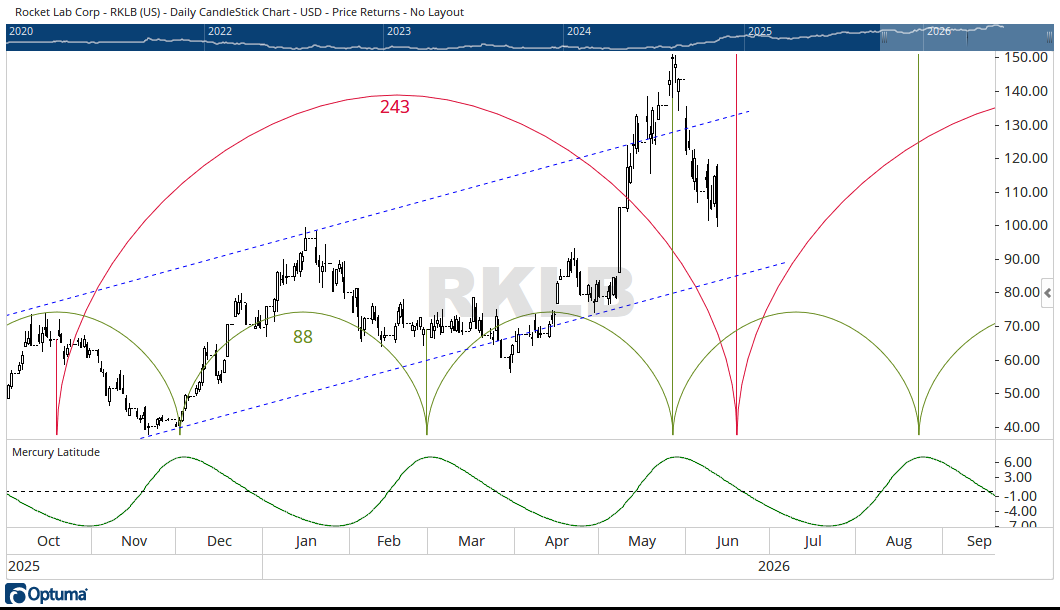
The price peak in late May (as the equity markets were also peaking) came at the end of an 88-day cycle. Next week will see the end of the current 243-day cycle.
Mercury at its minimum, maximum and 0-degree heliocentric latitude levels closely aligns to pivot point inflections on the daily price chart. Mercury will pass 0-degrees latitude next week just as the Venus 243-day cycle completes. I think it is possible that RKLB could test the lower bound ($90 level) of the channel shown on the above chart. The 4-Moon (118 day) moving average is right around this level as well.
Here and now, RKLB has retraced Fibonacci 61.8% of its move higher in May. A 78.6% retrace will take price to the $90 level.
The June 12 SpaceX event was a helluva party. Now we have to let the hangover go away. The next week or so will tell us more about space - the final frontier.
Planetary Trader is designed to raise investor awareness of how planetary movements in our cosmos affect our emotions and thereby the financial markets. This particular post is free for all to read. To receive new posts similar to this one on a frequent basis that free viewers do not see, consider becoming a paid subscriber. The monthly cost of subscribing is $10 Canadian per month (that’s $7 US per month). A small price to pay for some planetary knowledge that few other traders and investors have….