
Scandium
The little-known, critical mineral

Back on May 26, 2026 I wrote a Substack piece:
We hear about Rare Earth (REE) metals on a regular basis now.
· China controls the bulk of REE production.
· The administration in Washington has taken steps to start building a stockpile of critical minerals to counter the China threat.
One metal we hear little about is element #21 on the Periodic Table - Scandium.
It is typically found in small quantity in most REE deposits. It is also often found in ore bodies containing Niobium and Titanium. So it is not “rare” per se, it just occurs in small amounts mixed in with other minerals.
Why will we be hearing more?, you ask.
Adding scandium to aluminum creates lightweight, high-strength, and highly corrosion-resistant alloys. This is critical for aerospace manufacturing, where structural weight savings drastically reduce fuel consumption. And let’s face it - expect to hear more - lot’s more - about space investments going forward. Wall Street is going to judge space investments based on the cost to lift 1 kg of cargo into orbit. Reduce your cost by using light-weight metals in your rocket and your share price will move higher.
Scandium-stabilized zirconia alloys significantly increase the electro-conductivity of solid oxide fuel cells, making them highly efficient. Think Bloom Energy (N:BE) and its solid oxide fuel cells that are capable of powering everything from small towns to massive data centers.
High-strength aluminum alloys with Scandium will allow for significant electric vehicle weight reductions. Lighter vehicles will have a longer driving range. Consumers tend to judge EV’s based on their driving range. Even traditional gas-powered vehicles will benefit from these alloys. Lighter vehicles burn less fuel. The net pounds of aluminum per light duty vehicle is forecast to increase from 459 lbs. in 2020 to 570 lbs by 2030.
So, where does Scandium come from?
In that post, I went on to describe an Australian company pursuing a Scandium project.
In this post, I want to introduce you to a U.S. company advancing a Scandium project in Nebraska. To be fair, the project is really a Niobium (element # 41 on the Periodoc Table) project, but there is a substantial amount of Scandium mineralization in the carbonatite ore body buried beneath 640 acres of corn field in Nebraska.
This project has been known about for years now and it dates back to the days when Molycorp was leading the charge in the U.S. rare earth mining sector. If you are aware of the Mountain Pass, California rare earth mining project - that was a Molycorp discovery in the late 1940s. In my days of mineral exploiration in the U.S. southwest, I often came across areas where Molycorp had drilled back in the day.
Molycorp is no longer around and for that the globalization movement is to blame. Why tear up your own ground and irritate environmental groups when you can source your critical minerals from other countries?
This works until it no longer works. China was the main vendor of these critical minerals. That is, until China put on its big-boy pants and decided to pursue world domination.
Enter - Donald J. Trump.
You can say what you want about the man. You can criticize his unorthodox approach to politics all day long. But - the man had the foresight to realize America needed to develop its own inventory of critical and rare minerals. And that brings us to here and now…
The Nebraska project is marching ahead with determination. The Balance Sheet shows the Company to be good and well “cashed up”. Efforts are underway right now to build the access adit (downsloping entry tunnel) to the project ore mining area. Feasibility studies show a life of mine of near 38 years. There is a prolific amount of Niobium and Titanium in the ore body. More importantly, there is 14,000 tonnes of indicated and inferred Scandium in the ore body. At just under $3700 per kilogram, the Scandium content of this ore body screams one message - “this project is a money maker!”
The Company behind this project is NioCorp Developments (N:NB) and its management team has roots going back to the Molycorp days.
The next step in this whole project is to secure loans to fund the remainder of the project’s capex (estimated at just over $1 billion). The US Ex-Im Bank is currently reviewing NB’s application for a debt package. U.K. and German lending sources are also part of the overall discussion.
But I digress. Let’s get back on track with some planetary stuff…
Niocorp (N:NB) started trading in New York on March 21, 2023. At the time, Venus was at 0.42 degrees latitude, Mercury was at -3.30 degrees latitude.
Periodogram analysis shows that NB follows a 243-day cycle (Venus axial spin time) and a 58.65-day cycle (Mercury axial spin time).
Analysis also shows that events when heliocentric Mercury and Venus pass their March 2023 latitude levels, there is a price response.
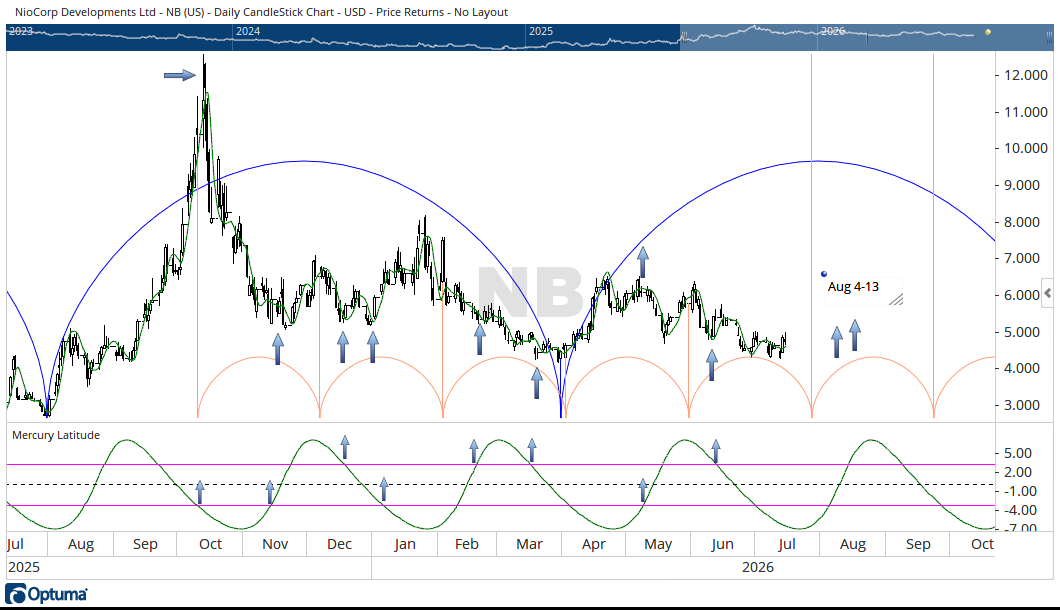
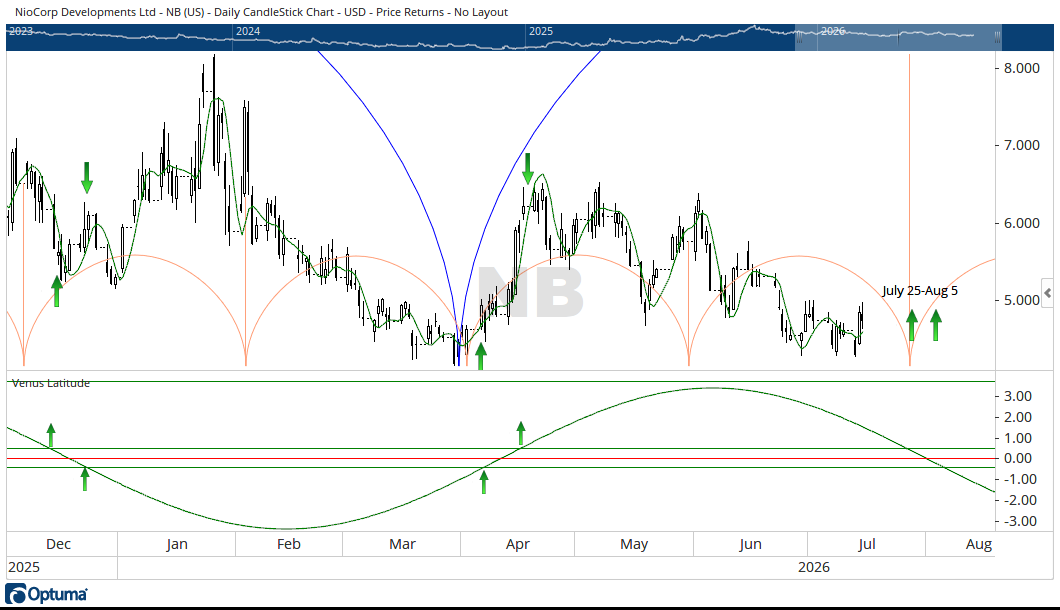
The next Mercury latitude event will occur in early August just after the 58.65-day cycle ends and right around the time of the 243-day cycle midpoint.
The next Venus latitude event will more closely overlap with the end of the 58.65-day cycle and the 243-day cycle midpoint.
In October 2025, NB made a significant high at just over $12 per share. Using this as a start point, if I project heliocentric intervals of Mercury forward, Aug 3 looks to be a key date. If I project intervals of Mars forward, Aug 10 looks to be a critical date.
From the Nov 26, 2024 lows, if I calculate Square of Nine intervals, I see that $4.58, $5.71, and $6.97 price levels all come into sight.
Add this stock to your radar screen. I thinking that it is about to make a pronounced move to the upside.
Oh - and by the way there are Options that trade against the stock. Now, that grabs my attention!
Planetary Trader is designed to raise investor awareness of how planetary movements in our cosmos affect our emotions and thereby the financial markets. This particular post is free for all to read.
To receive new posts similar to this one on a frequent basis that free viewers do not see, consider becoming a paid subscriber. The monthly cost of subscribing is $10 Canadian per month (that’s $7 US per month). You can’t even get lunch these days for $7. A small price to pay for some planetary knowledge that few other traders and investors have….
If your critical metals corp call is anything to go by… but at least it’s n that instance you actually gave your view on a likely outcome