
Space...
The next Wall Street fascination...

Wall Street is now fascinated with space thanks to the coming IPO of SpaceX.
In a Substack post on May 15, I showed you an alternative way of keeping time - by following the parallel and contra-parallel events of heliocentric Mercury and Venus. This is not a new technique - W.D. Gann was reportedly a user of this method.
To save you from wasting time digging up the May 15 post, here is how this method works:
At the first trade date of a commodity futures instrument (or the IPO date of a stock) take note of the latitude of heliocentric Mercury and Venus.
On a current price chart, fit the chart with plots of the latitude of these two planets. Pinpoint the times when the latitudes match the IPO/first trade latitudes. Pinpoint times when the latitudes are opposite in sign (contra-parallel) too. Moreover, also pay attention to events of Mercury or Venus at maxima or minima latitudes.
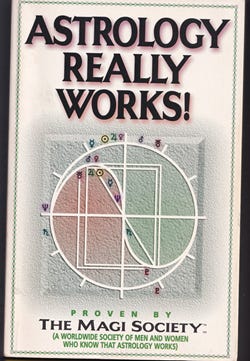
Here is the 1985 publication where I first uncovered this technique.
So what does this all have to do with space?, you ask.
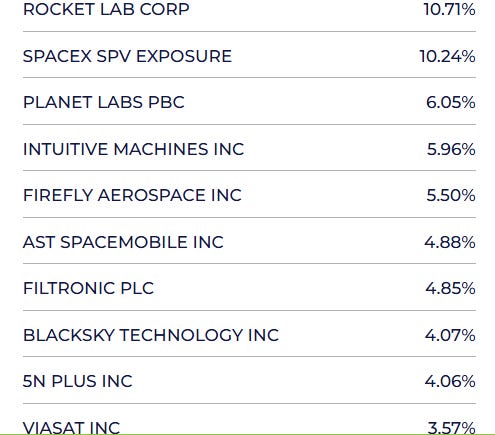
A new ETF has been launched by the folks at TEMA. They call the ETF the “Space Innovators ETF” and it trades under the ticker symbol….wait for it…..wait for it…. NASA. That’s original!
Its holdings as of now include:
Let’s bring this story full circle to see how planetary latitudes factor in…
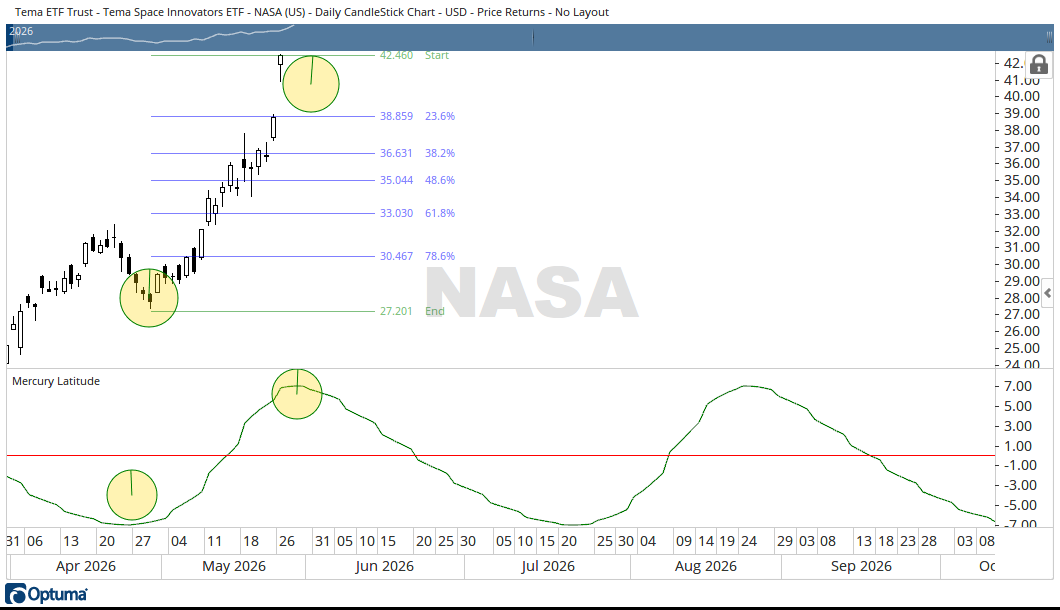
This ETF is very new, so not a lot of historical data to look at. From what I can see, there is a correlation between heliocentric Mercury latitude and price reaction.
Later this week we are headed into a Mercury latitude maxima event. As I showed subscribers to my Bull,Bear & Planets newsletter yesterday, the S&P and Nasdaq also have similar correlations to Mercury’s latitude events.
I would not be shocked to see the broader markets take a time out for a sideways consolidation starting soon. In the case of this NASA ETF product, a pullback would provide a better entry point. A pullback to the $33 level would be a Fibonacci 61.8% retrace.
So, if you believe space will be a money maker, add this ETF to your radar screen.
If you are unsure if space will be a money maker, take a peek at Space-X’s recent pre-IPO S1 filing with the SEC. The numbers revealed suggest (no surprise!) that it costs money to break the bonds of gravity and move a payload into space. The key is to maximize the size of the payloads and maximize the price charged. Running half-sized loads and discounting prices will not work.
Space is not a slam dunk money making machine - at least not yet. Give this ETF some time to settle down. As you watch the price, remain aware of heliocentric Mercury’s latitude. Watch for maxima and minima events…
Oh…and by the way, SpaceX will likely have June 12 as its IPO date. Venus will be at its heliocentric latitude maxima at that date. Coincidence?, you say….